
Friday, May 28, 2010
Another post soon!

Tuesday, May 25, 2010

Sunday Ndii arranged for us to go to an African church. We had a unique experience at a Jehovah’s Witness church, which is not a typical African church experience. The church brothers and sisters were very kind and welcoming. Here is a photo of us all dressed up.

After church, one of Ndii’s childhood friends had us over for a traditional lunch. It is truly generous to have 22 people over for lunch! We had the traditional food, including worms, spinach, beans, etc. We took the rest of the afternoon off, and people hung around playing games, reading, writing and generally decompressing. There were also quite a few trips to the neighborhood Supa Dupa, our favorite Oshakati grocery store.

The Supa Dupa, our favorite store
Monday we went back to work, and had another full day touring the Oshana region. We first went to the Oshakati State Hospital and had a briefing with the Director of Health of the region.


Then we met with the social workers at the Ministry of Health and Social Services. They briefed us on social welfare services in the area, and now that we’ve been in the area for a week, we were able to ask a lot of questions to really get a deeper understanding of how things are structured. The MoHSS social workers then accompanied us for the rest of the day, as we toured various NGOs. We went to the SOS Children’s Village – a homecare setting for Orphans and Vulnerable Children, which is an NGO still getting on its feet in the region as they are waiting for children to be referred to them.


We also visited TKMOAMS, a very impressive grassroots NGO that provides services, outreach and support for people infected and affected by HIV and AIDS. They have a number of volunteers who provided home services for people with HIV, and also have income generating projects. One of the neatest ones they had was a bicycle project, which is affiliated with the Bicycle Empowerment Network (BEN) of Namibia. BEN gets containers of donated old bikes and bike parts from the West, and brings the containers to NGOs or other groups out in the regions. They then train several people to be bike mechanics, and then they can repair the bikes and sell them. The container itself becomes the shop. Very cool.


Next, we visited the regional office of Catholic Aids Action. They have almost 800 volunteers who work for them doing outreach and support for people affected by HIV. It was great to see the work in the regions that Father Rick had talked about in Windhoek.


Finally, we visited the Flood Victims Resettlement Camp. For the past 3 years, there have been extensive floods in the Oshakati area, and many people are displaced from their homes. There are large tents set up where 3-5 families live. People were kind enough to show us around their tents and tell us a little about what it is like to stay there. We were sort of surprised that it seemed as if there was nobody or no organization in charge of the tent city, and the social workers accompanying us thought that people received donations, but there were no staff, security, or other type of support for these people.


May 25th is Africa Day! We slept in on Africa Day, which was our treat to ourselves. After a good rest, we went up to visit Penny’s parents’ traditional homestead. It was fascinating to see what the traditional Ovambo homesteads look like. These are generally an area that is enclosed with sticks tied together, and then there are a number of huts with various purposes – the kitchen, storage shed, sleeping quarters, etc. The particular homestead we visited was very nice, and the Tate (grandpa) and Meme (grandma) were gracious to show us all around. We saw how they harvested and pounded the mahangu, where they cooked and slept, and learned about how the family members interacted. Even Ovambo people who live in Windhoek usually have a homestead up north to come home to.


We were close to the Angolan border, so we went ahead and drove right up to the border town, and walked around the market a bit. Even though many of the stores were closed, it was still one of the busiest places we have seen in Namibia, with all the trading going on. Many Angolans come to Namibia to shop these days.
Angolan border
Sunday, May 23, 2010
UNAM & Treesleeper

Friday morning we packed up from Puccini House for our trip up to the Northern part of Namibia. We first made a stop to the University of Namibia, where we spent about 3 hours with the social work faculty and students there. The social work students at UNAM are primarily from southern African countries, and the students we met were mostly 3rd and 4th year students. The UNAM social work lecturers and the UNAM Student Social Work Society made a formal program for us, which included an introduction to social work in Namibia by Janeta Ananias, and a discussion of the Herero Genocide and reparations movement by Esther Utjiua Muinjangue. The students then broke into groups, with about 8 UNAM students meeting with 1 or 2 U of Minnesota students. The students talked about social work in their various home countries, as well as more fun topics (such as “what do your shoes represent about you?”). The discussions apparently went well, as by the end, everyone was trading email addresses and promises to become Facebook friends, and the president of the Student Society wants to set up a formal relationship with our students at Minnesota.

Esther Muinjangue


We then climbed on the bus for our first long bus ride. We drove north up to Tsintsabis, about a 700 kilometer drive – most of the time on a major highway, the rest on a gravel road. The last few kilometers is a really rough road, and the bus barely made it through (and I thin
This is the Major highway

Our destination was the Treesleeper Camp. The Treesleeper Camp is owned and operated by the San people, one of the most marginalized groups of people in Namibia. They started this camp as a way to provide jobs for the some of the 3,000 people living in the area, to help protect the San culture, and to raise money for the community. The Treesleeper Camp is owned by two of the San tribes, and is managed by the quite remarkable Moses, one of only 9 San to have graduated from a university since Namibia got independence in 1990. Up until last year, Treesleeper was the major employer in Tsintsabis - with 7 people working at Treesleeper, and about 5 others working in town. In the five years that it has been open, Treesleeper has been able to get enough profits to build the first kindergarten in the area and is sending a number of kids to primary school now.

Treesleeper was named for the San tribe that lived in Etosha and slept in trees. At Treesleeper, they have built platforms so that you can camp in the tree as well. They set up one tent in the tree, and the rest were set up for us around in the bush.

Right after we got to Treesleeper, we were led to a fire where we were shown traditional San healing and other dances around the fire. A healer also came around and touched our cheeks to combine our spirits. A young San man was our guide for these dances.


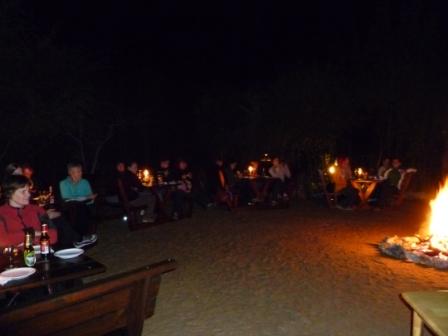
After dinner, we walked back to the camp, and they had set up picnic tables around a fire, and we were served outside under the stars. A San church choir serenaded us while we were eating.

The Treesleeper has a Boma looking over a dry river bed. We enjoyed eating our breakfast and lunch here.


Camping

Frisbee Action at the Camp Site

Nancy J throwing the disc

Eric climbing the trees

The highlight of our trip to Treesleeper was the Village Tour given by Moses. Moses is an incredibly smart, young man who is clearly a future leader of the San. His knowledge of San culture, history, politics, economics, wildlife etc. were all incredible, but perhaps his best quality is his way he relates to his elders, which is full of respect and humility. We were all completely impressed.

Moses took us on a LONG, HOT walk from our campsite to the villages where the San live.

We first stopped at the local shop to buy some gifts for the families we were visiting - maize meal, sugar, tea, oil, and a candle.

We visited two different families, each from one of the two main tribes living in the area. They rotate the visits among families. With each visit, we first greeted the elders, and then were told a little bit about the family. Moses then acted as our translator, and we could ask the elders or others in the family most any question we wanted.

Anna meeting the elder

The elder and his wife

Emma meeting the second family


On our way back, three hours later.

The whole group at Treesleeper


